
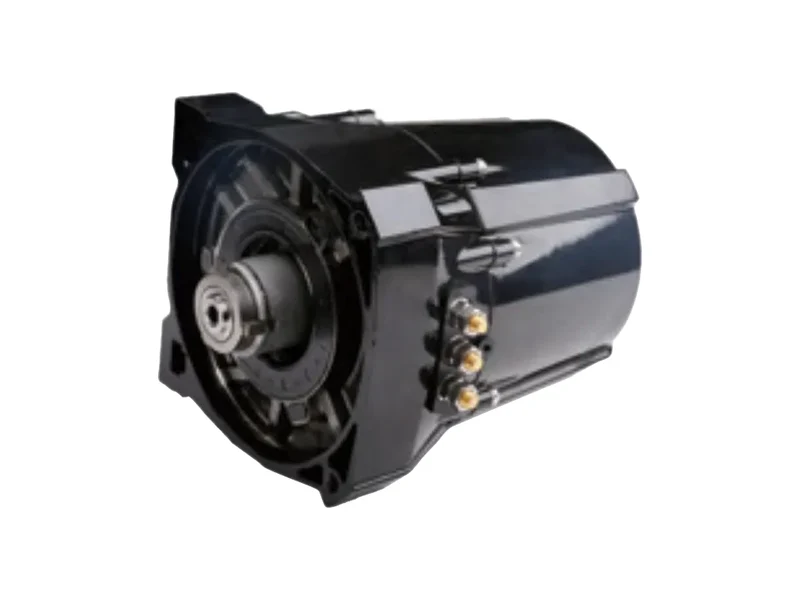
Winch motor failure typically traces back to three root causes: thermal overload during stalls, water ingress shorting the armature, and mechanical brush wear. Selecting the right motor topology and IP rating prevents these failures, ensuring your OEM winch delivers consistent pulling power without premature field replacements.
Why Does Winch Motor Failure Occur Under Heavy Loads?
A winch motor's primary function is to convert electrical energy into high mechanical torque at low rotational speeds. When a winch is heavily loaded or completely stalled, the back-electromotive force (back-EMF) drops to near zero. The only physical property limiting the electrical current is the armature resistance, which is intentionally kept very low. This causes a massive current spike.
If the operator holds the stall for too long, the I²R losses generate immense heat inside the housing. This thermal overload melts wire insulation, warps the commutator, and ultimately destroys the armature. This thermal stress is the most common driver of winch motor failure.
This is why strict adherence to duty cycle ratings is critical. Winch motors are designed for intermittent use, not continuous operation. For example, the BT12000PLT is rated for 2000W and 6 N·m of torque, but only at an S2 2-minute duty cycle or an S3 7% duty cycle. Exceeding this thermal limit guarantees premature failure.
Furthermore, voltage selection directly dictates current draw. Operating at a lower voltage for the same power output doubles the current, which quadruples the heat generated. We cover the thermal and electrical implications of voltage choices in detail in 12V vs 24V DC Motors: Which Voltage for Your Application?.
How Does Water Ingress Accelerate Winch Motor Failure?
Winches are typically mounted on the front of vehicles or exposed on marine equipment, leaving them vulnerable to rain, mud, road salt, and full submersion during recovery operations.
When water breaches the motor housing, it immediately washes away the protective lubricating film on the carbon brushes and commutator. This lack of lubrication causes rapid, abrasive brush wear. Worse, conductive water creates short circuits between the commutator segments. This leads to severe electrical arcing, pitting of the copper bars, and eventual armature destruction.
To prevent this, the enclosure IP rating must match the operating environment. An IP54-rated motor like the BT682169 (12V, 2000W, 6 N·m) is protected against dust ingress and water splashes, making it suitable for standard trailer winches kept relatively clean and dry.
However, for severe off-road, industrial, or marine environments, IP67 sealing is mandatory. The BTMS1210 (12V, 2200W, 8 N·m) features full IP67 sealing, allowing it to withstand temporary submersion without internal contamination. The physical differences in sealing requirements, testing protocols, and environmental matching are broken down in IP54 vs IP67: Waterproof Ratings in DC Motors Explained.
Series-Wound vs. Permanent Magnet: Which Topology Prevents Winch Motor Failure?
The internal magnetic field topology drastically affects how a motor handles electrical and mechanical abuse. Winch motors generally use either series-wound field coils or permanent magnets (PM).
Permanent magnet motors are lighter, cheaper to manufacture, and highly efficient at partial loads. However, they have a critical vulnerability: high stall currents generate a strong opposing magnetic field that can permanently demagnetize the stator magnets. Once demagnetized, the motor loses its torque capacity and must be replaced.
Series-wound motors use copper field coils instead of magnets. They are heavier and slightly less efficient at light loads, but they excel in heavy-duty winch applications. The series field actually strengthens as current increases during a stall, providing massive peak torque without the risk of demagnetization.
| Feature | Series-Wound Winch Motor | Permanent Magnet (PM) Winch Motor |
|---|---|---|
| Stall Torque | Very high (field strengthens with current) | High, but limited by demagnetization risk |
| Demagnetization Risk | None (uses copper field coils) | High if stalled for extended periods |
| Weight & Size | Heavier and larger for equivalent power | Lighter and more compact |
| Cost | Higher material and manufacturing cost | Lower cost |
| Best Application | Heavy-duty vehicle recovery, industrial winches | Light-duty trailer winches, intermittent light loads |
For heavy-duty OEM applications where the winch might be asked to pull a stuck vehicle out of deep mud, a series-wound topology is the standard engineering choice to avoid catastrophic winch motor failure under extreme stall conditions.
Avoid winch motor failure by respecting the S2/S3 duty cycle limits, specifying the correct IP rating for the operating environment, and choosing a series-wound topology for heavy stall conditions. If you are engineering a new winch system and need to specify a motor that balances torque, thermal limits, and environmental sealing, our engineering team can help. Request a technical consultation and quote at /quote/.